
The preacher heard from a mutual friend that Sherry Cannon was crumbling from loneliness, perhaps more so than many during the pandemic.
She’d already buried her husband, a 24-year-old son and both parents in less than an eight-month span when the pandemic struck. COVID-19 stay-at-home recommendations kept the widow isolated at her Collierville home at the worst possible time, a time she needed people most.
And while her pastor, Rev. David G. Atkinson, could not do the normal thing – walk into her home, sit on her couch, trade lighthearted stories – he could do the extraordinary thing.
He showed up and sat in her driveway. She sat on her porch. While they physically distanced, the pastor fed her lonely soul with presence.
“I used to talk to five people every day and four of them were dead,” said Cannon, 65. “But what David did was just so far above and beyond what any preacher or minister does. So, when he died, it was like another kick in the gut.”
Atkinson, 60, senior pastor of Collierville United Methodist Church since 2015, died of COVID-19 complications April 7, the Wednesday after Easter.
The news spread to church members quickly.
“The only place I knew to go to is the church,” said Cannon, who lives within easy walking distance to the church. “It’s like home to me.”
She arrived to find the staff in a lumbering shock. They’d just been told the news, and in the emotion of the moment, broke protocol. They embraced Cannon, who was crying.
“We hugged her,” Associate Pastor Tondala Hayward said, “because this is about family.”
***
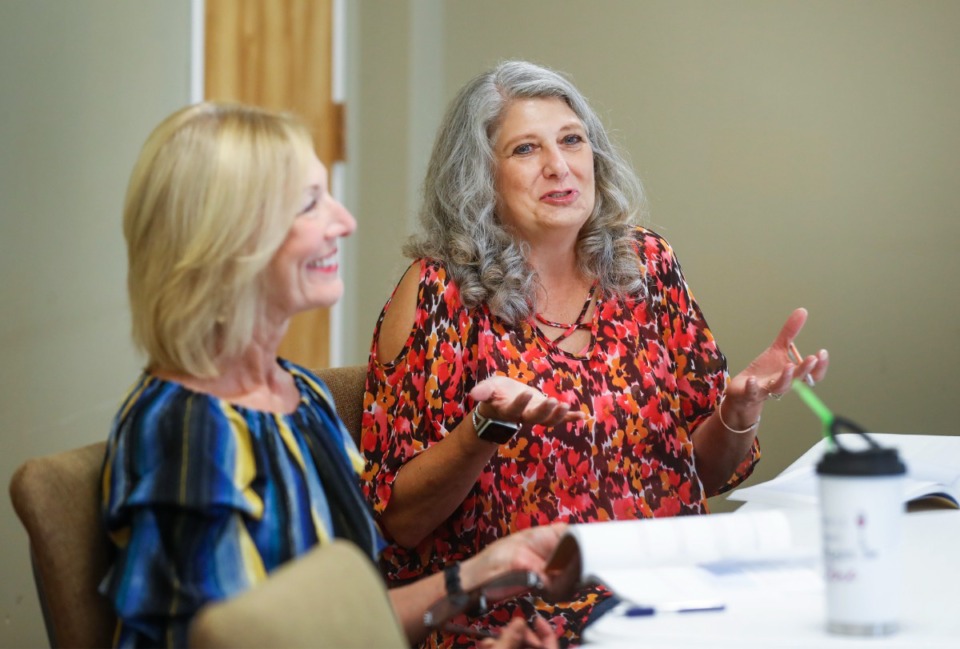
The church’s senior adult suite is furnished with a kitchenette, a white board and four long tables, pushed together to make a square.
It was in this room nearly four months ago that Hayward put on music and began to draw up a plan for the church to grieve together.
Years earlier, Hayward’s mother, an aunt and a cousin died within months of one another. The former kindergarten teacher also had witnessed counselors activated by the suicide death of a middle school student.
“I knew the importance of grief,” she said.
But she was not alone. Collierville United Methodist Church is what one might call grief intelligent. The church is home to one of the city’s handful of Stephen Ministries, a program that pairs a person suffering from loss with their own trained lay person for a year.
Leaders announced at worship services that followed Atkinson’s death that the Stephen Ministers were available to speak to individuals if so desired.
“We had never experienced anything like this,” Hayward said of her church, “but we knew it was something we needed to do collectively because we are a church family.”
In many ways, what the church has been doing collectively mirrors what individuals are called upon to do to process a death.
Mourn the loved one. Survive the pain. Stretch toward a new kind of tomorrow.
It’s what millions have been called to do with COVID-19 still taking lives more than 16 months after shutdowns and social distancing became the norm. It’s been called a “grief pandemic.”
Collierville United Methodist had unified in prayer for Atkinson’s healing in places like Cathy Hisky’s weekly Bible study. After he died, the staff elected to keep a date for a prayer service and set up the meeting for multiple members to contribute.
“We put up microphones,” Hayward said. “If you wanted to come up and say something, you could. We thought it was very important for our church members to share.”
The staff, which had worked directly with Atkinson, met every other week and shared lunch “to check in on one another,” the associate pastor said. “David’s death brought out other death experiences related to COVID and not related to COVID.”
Renee Dillard, a licensed clinical social worker and an ordained Methodist minister, led a “debriefing” for staff. As a member of Methodist Le Bonheur Healthcare’s employee assistance professional team, Dillard assists companies after critical incidents or loss of an employee.
“That process of remembering together is one of the powerful ways to begin to make sense of the loss,” Dillard said.
Harry Durbin, a former pastor of Collierville United Methodist, came out of retirement to serve as interim pastor. Hayward credited his “calming, peaceful soul” for bringing a lot of comfort to the church at a sensitive time.
“We didn’t want to appoint anyone (to replace Atkinson) too soon,” Hayward said. “You’ve got to allow the church to grieve and build the church up to be ready to accept someone.”
Durbin, Executive Pastor Deborah Suddarth and Hayward shared duties to compose devotionals geared toward issues related to loss and healing. The devotionals are published online weekly for members. Hayward’s July 21 message appropriately addressed transformation.
During worship services Aug. 1, the congregation learned Suddarth will become senior pastor to replace Atkinson. She was selected by the Methodist bishop and council and will begin her new job Sept. 1.
The arrival does not end the grief process for the Collierville church. Not everyone will grieve at the same pace, and after all, Atkinson has not been gone long.
“What do we still need to do?” That’s the question Hayward asks going forward.
The newsletters will continue. The prayers for Atkinson’s family will as well. And Atkinson’s legacy will help keep the church strong.
Mike Ware, a former Stephen Minister at Collierville United Methodist, will remember Atkinson’s example of superb listening skills.
The pastor ended their meetings with prayer and then always issued the same departing phrase – “be at peace.”
Keys to navigating grief
- Give Permission to Grieve – We share many grieving rituals but sometimes even within shared grief, there are spoken or subtle messages to suppress expressions of loss. Be intentional and remind one another that grieving is okay, with no timetable attached.
- Connect on a Regular Basis – Check in and offer invitations to discuss the feelings and thoughts individuals are facing. While social distancing may not allow for in-person visits, it is imperative to connection in some way, perhaps a phone call or letter.
- Be Ready to Offer Assistance – Because people grieve differently, be ready to recognize when someone might need to go a step further and get professional counseling. Offer specific resources that people can plug into easily.
Source: Renee Dillard, a licensed clinical social worker with Methodist Le Bonheur Healthcare’s Certified Employee Assistance Professional team